
1
Call us or fill out our form — getting started takes about 5 minutes. Tell us what happened. We'll review your information and get back to you fast to discuss your case. No pressure.
4.9 Google Rating
13 Reviews
You need a team that knows Jacksonville.
TopDog fights to get you the money and care you deserve.

See how much your case may be worth
Start Online → Then Work with our Team
Florida recorded 3,184 traffic fatalities and 381,210 total crashes in 2024 according to the Florida Department of Highway Safety and Motor Vehicles. Duval County reported over 24,000 crashes with more than 200 fatalities according to FDOT and JaxStats data for 2023, making it one of Florida's most crash-prone counties. Jacksonville was designated a federal Focus City for pedestrian and cyclist fatalities. I-95, I-10, and I-295 through Duval County are among the most dangerous corridors in Northeast Florida. Beyond car accidents, thousands of Jacksonville residents are hurt every year in slip and falls, workplace accidents, and medical negligence. TopDog fights to get you every dollar you deserve.
Our office is on Dennis Street near the Riverside and Mixon Town neighborhoods — close to the communities we serve across Jacksonville's Northside, Westside, Northwest Jacksonville, and New Town. Philips Highway, US-1, and I-95 through the Southside and urban core are among the most dangerous corridors in Duval County. UF Health Jacksonville — Duval County's public Level I trauma center — and Baptist Medical Center serve the communities where our clients live and where serious injuries bring people for care. Those accidents cause real damage to Jacksonville families and we fight to get injured people the care and money they deserve.
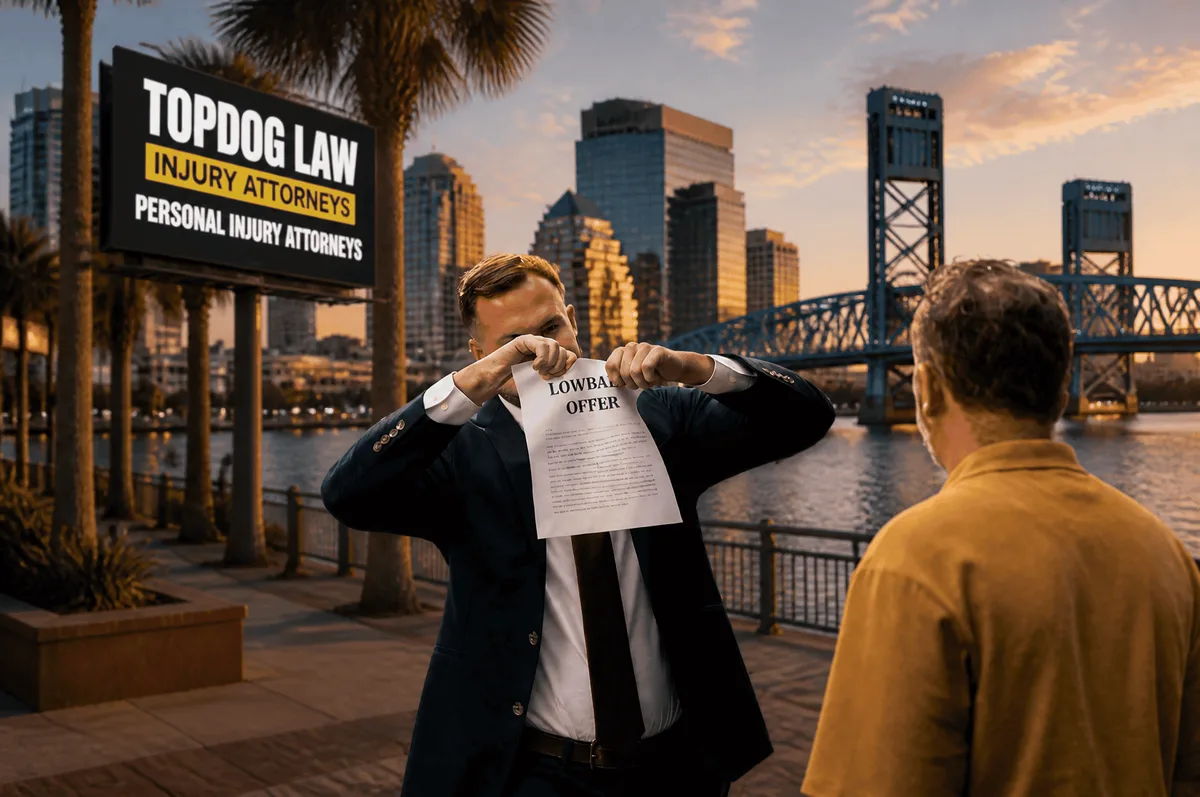
Insurance companies operating across Duval County often use delay, deny, and lowball tactics against Jacksonville families who are already stretched thin. Florida's 2-year statute of limitations — reduced from 4 years in March 2023 — means insurance companies count on time running out before you act. We know how to fight back for what you may be owed.
IMPORTANT FLORIDA LEGAL INFORMATION
Statute of Limitations (Major 2023 Change): 2 years from date of injury for most personal injury cases — Fla. Stat. § 95.11(3)(a) as amended by HB 837 (effective March 24, 2023). For injuries before March 24, 2023: the prior 4-year deadline applies. This halving of the deadline is one of the most significant recent changes in Florida tort law.
Wrongful Death: 2 years from the date of death — Fla. Stat. § 95.11(5)(e). Different from the general PI deadline. Medical malpractice: 2 years with a hard 4-year repose.
Government Entity Notice (Critical — Fla. Stat. § 768.28): Claims against the City of Jacksonville, Duval County, JTA buses, JEA, FDOT, or any Florida government entity require: (1) Written notice to the agency and Florida Department of Financial Services within 3 years of the incident (2 years for wrongful death); (2) A mandatory 180-day investigation period before you can file a lawsuit. Damages are capped at $200,000 per person / $300,000 per occurrence, with ongoing legislative pressure to increase these caps.
Comparative Fault (2023 Change): Modified comparative fault with 51% bar — Fla. Stat. § 768.81(2)(6) (HB 837, effective March 24, 2023). If you are more than 50% at fault, you cannot recover non-economic damages. Your award is reduced proportionally if 50% at fault or less. Note: Medical malpractice cases still use pure comparative fault — HB 837 did NOT change the med mal standard.
Auto Insurance (No-Fault State): Florida requires $10,000 PIP and $10,000 Property Damage Liability. Bodily Injury Liability is NOT required for basic registration but is strongly recommended.
This is a brief summary of commonly applied laws in the jurisdiction. There are often different laws that apply to different circumstances. Once you hire TopDog, your attorney will advise you on the applicable laws.
Insurance companies may make early low offers because they count on most people not knowing what their case is worth — and on Florida's 2-year SOL running out before you act. They may delay, deny, and lowball — counting on financial pressure. TopDog fights for the full recovery.
See individual case type pages for case-specific values.
Recoveries by TopDog Law and its co-counsel. Past results do not guarantee similar outcomes in your case.
See how much your case may be worth
Call us or fill out our form — getting started takes about 5 minutes. Tell us what happened. We'll review your information and get back to you fast to discuss your case. No pressure.
Get medical attention and document everything — your health comes first. Keep records of every doctor visit, every bill, every day you missed work or could not do what you normally do.
Do not talk to insurance without us. They may use delay, deny, and lowball tactics from the moment you pick up the phone. Anything you say can be used to reduce what you are owed. Let TopDog handle them.
Time Is Critical
In Florida you have only 2 years to file — reduced from 4 years in March 2023. The clock is already running. This is a general summary — deadlines vary. Contact TopDog Law to confirm what may apply in your situation.
You bring your case. TopDog brings the resources, the experience, and the track record to win.
120,000+ people helped across the country
$800M+ won for our clients
6,000+ five-star reviews
No fee unless we win
Aggressive representation against insurance companies
Resources, Experience & Track Record to Win
Verified Google reviews, recoveries and statistics by TopDog Law and its co-counsel.
Severe head trauma requiring long-term rehabilitation and care.
Injuries to the spine that can result in paralysis or chronic pain.
Third-degree burns requiring extensive medical treatment and skin grafting.
Loss of limbs requiring prosthetics, rehabilitation, and lifelong care.
Complete or partial loss of movement and sensation affecting daily life permanently.
Injuries to vital organs requiring surgery and ongoing medical care.
Life-altering injuries that prevent a return to normal work or daily activity.
When a loved one's life is taken due to someone else's negligence.
We don't just talk tough. We deliver results. Every single day, we're fighting insurance companies who want to pay you nothing. We know their tactics. We know their lawyers. And we know how to win.
4.9 Average Rating| Based on 13 Reviews
Real stories from real people who got the legal help they needed from our service.
"Top Dog Law provided exceptional support and expertise during my hit and run case. Their professionalism, dedication, and clear communication made a challenging situation much easier to navigate. They truly went above and beyond to ensure the best possible outcome for me. I highly recommend their services to anyone in need of strong legal representation. Thanks Top Dog!!!!"
"Top Dog Law has been amazing throughout my case. They were professional, responsive, and truly made me feel supported every step of the way. They explained everything clearly, kept me updated, and fought for my best interest. I'm very grateful for their hard work and would highly recommend them to anyone needing legal representation"
"My experience with Top Dog Law made it easy for me to file with them my lawyer always kept me in the loop of things and made me have confidence in them. If I ever need a lawyer again that's who I'm calling Top Dog Law ."
"After calling 3 law offices and lead to believe that I didn't have a case. TOP DOG not only picked up my case but explained in detail why myself and daughter have a huge case. TOP DOG got the ball rolling on my case. It's been an effortless process and I am so grateful!"
"I love the team that's working with me today. They're very encouraging, very supportive, and I believe that they're going to win this case for me. They talked to me about the things that they're going to do for me, and I'm very happy with the attorneys the top dog assigned me to."
Your Story Matters!
Find answers to common questions about personal injury law in Jacksonville and how we can help you.
Contact TopDog Law for a free, no-obligation consultation
Its Easy to Get Started
This helps us match you with the right attorney.
No obligation and its free unless we win.
Don't settle for less. Our experienced attorneys fight to maximize your compensation in Jacksonville. Free consultation. No fees unless we win.